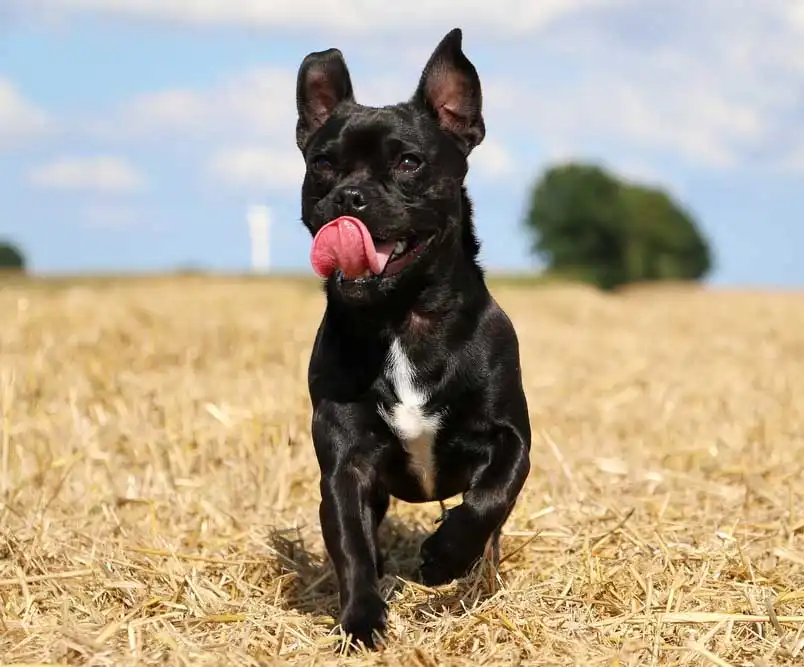
American Pugabull
The Pug has its origins in China and became a beloved pet among European royalty. Its popularity surged during the Victorian era, leading to its depiction in numerous artistic forms such as paintings, postcards, and figurines. On the other hand, the American Bulldog was bred for the now-banned practice of bull-baiting and was utilized as a hunting and guard dog by farmers and ranchers. Both breeds are recognized for their considerable shedding. Moreover, they are both great with children and exhibit a deep loyalty to their families.

Breed Origin
The American Bulldog, as we know it today, has its roots in Alabama and Georgia. Originally called “White English” or “English White,” this breed received its names due to its mostly white fur. Historically, these dogs were employed for bull and cattle catching, and in the Southern states, they were often referred to as the “Alabama” dog. Beyond their herding roles, they also acted as protectors of farms. In contrast, the Pug has a more distinguished history, having been valued in ancient times as a companion in royal courts and later as a beloved pet among European nobility in the 1600s. Following the Civil War, Pugs arrived in the United States and gained official recognition from the American Kennel Club in 1885. Unlike the Pug, the American Bulldog is recognized by the United Kennel Club instead of the AKC. The Pugabull, a crossbreed of these two dogs, remains quite rare.
Breed Appearance
American Pugabulls do not adhere to a specific color or marking scheme. They are usually fawn-colored, much like the typical Pug, and often display black markings. In contrast, the American Bulldog comes in a diverse array of colors, such as red brindle, white, red, brown, tan, fawn, and piebald. As a result, Pugabulls can exhibit any of these hues or their combinations. Both breeds have short hair and do not possess a waterproof coat, sharing a similar softness and density. It's important to note that there is a considerable size disparity between the two parent breeds. Typically, an American Pugabull reaches a size comparable to that of an English Bulldog, closely mirroring its physique.


Care Routine
The American Bulldog generally experiences a moderate level of shedding, while the Pug tends to shed more consistently throughout the year. Consequently, it is reasonable to expect that a Pugabull will shed at least an average amount, if not slightly more. Both parent breeds have short coats, so it’s beneficial to brush your Pugabull weekly, with increased frequency during shedding periods. Bathing should be limited to instances when it is genuinely necessary. For optimal dental health, aim to brush your dog’s teeth at least three times a week, although daily brushing is preferable to prevent tooth decay and bad breath. Nail trimming should be done bi-monthly; if you can hear your dog’s nails clicking on the floor, it’s time for a trim. Establishing a grooming routine early in your puppy’s life is advisable to help them adapt comfortably.
Behavior & Temperament
The Pug is a lively and friendly small breed, while the American Bulldog is celebrated for its protective instincts, loyalty, bravery, and alertness. When these characteristics are combined, you get the Pugabull, a hybrid that showcases loyalty, energy, courage, and a sociable nature. Although the Pugabull may not match the Pug's high energy levels, it still needs regular mental and physical stimulation. Pugs can occasionally exhibit a behavioral issue known as Small Dog Syndrome, which arises not from the breed itself but from the way humans engage with them. It’s vital for a Pug to see its owner as the dominant figure. Likewise, the American Bulldog flourishes with strong leadership; without it, he may assume the role of the pack leader. As a result, the Pugabull might also develop this leadership mindset, highlighting the importance of being both firm and consistent during training.


Play & Exercise
The American Bulldog is a lively breed, but its activity level can diminish when kept indoors, especially as it grows older. On the other hand, the Pug is a fantastic indoor pet because it requires minimal exercise. However, both breeds can get into mischief if they don’t receive enough physical activity. Since the Pug has a brachycephalic (short-nosed) structure, it’s crucial not to leave a Pugabull outside without supervision for long stretches. Brachycephalic dogs are prone to overheating, so it’s essential to approach exercise for your American Pugabull with caution.
Things to Know
Cups Per Day
0.0 Cups
Daily Activity
0 Minutes
Average Lifespan
14 Years
Origin
Unknown
Type
Crossbreeds
Size
Not Set
Origin Country
United States
Brush Frequency
Daily
Coat Texture
Straight
Register
Your kids have been begging for a pet forever, and you've recently decided that it's time for your family to get a new addition -- a dog! While everyone is excited for the new arrival, you're wondering if you need to have a dog license. How much does it cost? Is it required? Where do you get one?
Member Clubs

PETINNATE
Other
Height & Weight
Weight
48 lbs (22 kg)Male: 48 lbs (22 kg) , Female: 48 lbs (22 kg)
Height
15 inches (38 sm)Male: 15 inches (38 sm) , Female: 15 inches (38 sm)