Beardoodle
The Beardoodle is a medium-sized dog breed that emerges from the combination of a Bearded Collie and a Poodle. Adult Beardoodles typically weigh around 50 pounds and stand approximately 21 inches tall. Their coats are long and thick, often appearing in various shades such as black, brown, or blue. Renowned for their friendly disposition, Beardoodles are wonderful family companions and usually get along well with both children and other pets. To foster positive interactions with other animals and visitors, early socialization is crucial. These dogs are known for their intelligence, bravery, and ease of training, making them relatively straightforward to teach. However, they do need plenty of exercise to keep them engaged and prevent boredom.
Breed Origin
The origins of the Beardoodle are somewhat enigmatic, as this hybrid breed is relatively new. To grasp their background, one must delve into the histories of their parent breeds: the Bearded Collie and the Poodle. The Bearded Collie can be traced back to Scotland in the 1500s, where it served primarily as a sheep herder. This breed is thought to have descended from the Magyar Komondor, also known as the Lowland Polish Sheepdog, which originates from Central Europe. Historical accounts suggest that Polish traders introduced these dogs to Scotland in 1514. A significant portrait from 1771 features the Duke of Buccleuch with a Bearded Collie, representing the earliest known visual evidence of the breed. Celebrated for their herding skills, Bearded Collies were also proficient in driving cattle across rugged terrains. Originally, there were two distinct types of Bearded Collies: the border variety, known for its brown and white coats, and the highland variety, which displayed gray and white fur. Over time, these two types were interbred, resulting in a unified breed. Sadly, the Bearded Collie came close to extinction in the early 1900s, but Mrs. Willison of Bothkennar Kennels began breeding them for show. In 1955, she founded the Bearded Collie Club of Britain. The first litter of Bearded Collies in the United States was born in 1967, and the breed received recognition from the American Kennel Club in 1976, currently ranking as the 126th most popular breed. Conversely, the Poodle is one of the oldest and most esteemed dog breeds, with its origins in Germany dating back to the 8th century. Its development was further refined in France through crossbreeding with various European breeds, including the French, Hungarian, German, Portuguese, Spanish, and Russian Water Dogs. There is also speculation regarding its ties to the North African Barbet. Initially bred for hunting and retrieving, the Poodle eventually made its way into the show ring, showcasing its intelligence and grace. The American Kennel Club officially recognized the Poodle in 1887, and it now ranks as the 7th most popular dog breed in the United States.
Breed Appearance
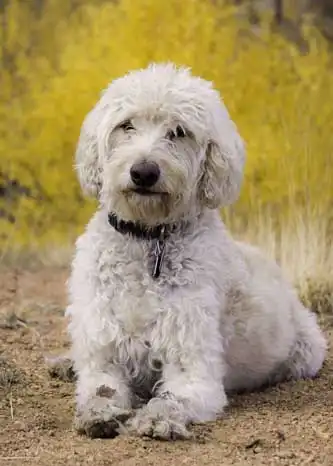
The Beardoodle is a medium-sized dog known for its captivating almond-shaped eyes, which can be brown or amber, and its nose, which may be black or brown. Typically, this breed stands between 20 and 22 inches tall and weighs around 40 to 60 pounds, showcasing a keen intelligence. It has floppy ears, an elongated muzzle, and a dense, wavy coat that often comes in various shades, including black, brown, or blue. Inherited from its Poodle ancestry, the Beardoodle experiences minimal shedding, though some hair loss can occur during shedding seasons. Its legs and tail are long and fluffy, while its head is mostly rounded, and its body is both sleek and muscular.


Care Routine
To ensure your Beardoodle's coat remains healthy and free from tangles, it's important to brush it thoroughly with a pin brush and metal comb at least four to five times a week, although daily grooming is preferable. When needed, utilize a dematting tool to remove dead hair and prevent knots. If your Beardoodle has a particularly dense coat that is prone to matting, regular trims may be necessary. Additionally, make it a routine to clean your dog's ears weekly with a damp cotton ball, looking out for any signs of redness, irritation, dirt, or debris. Remember to trim her toenails as required and brush her teeth once or twice a week to support good dental hygiene.
Behavior & Temperament
The Beardoodle makes a fantastic family pet due to its affectionate nature towards all, as long as it receives adequate socialization during its early puppy days. Renowned for their intelligence, these dogs can quickly master a variety of tricks. Training them is typically uncomplicated, especially when using positive reinforcement methods, which also aid in effective housetraining. While they enjoy attention, Beardoodles are generally comfortable being alone, which helps ease worries about separation anxiety. They are lively, alert, and love to interact with both children and other animals. However, it’s crucial to supervise their interactions with very young children who are not yet in school.


Play & Exercise
This breed flourishes with plenty of activity and loves to demonstrate its abilities, similar to a Poodle, while also embodying the strong work ethic of a Bearded Collie. To keep her mentally stimulated and physically fit, it’s crucial to ensure she gets at least one to one and a half hours of intense exercise daily. She enjoys various activities, including agility training, playing frisbee or flyball, hiking, swimming, and leisurely walks around the neighborhood. Moreover, she would greatly appreciate the chance to interact with other dogs at a local dog park. Without adequate physical engagement, the Beardoodle may become restless and potentially develop behavioral problems.
Things to Know
Cups Per Day
2.5 Cups
Daily Activity
90 Minutes
Average Lifespan
14 Years
Origin
2000s
Type
Crossbreeds
Size
Medium
Origin Country
United States
Brush Frequency
Daily
Coat Texture
Wavy
Register
Your kids have been begging for a pet forever, and you've recently decided that it's time for your family to get a new addition -- a dog! While everyone is excited for the new arrival, you're wondering if you need to have a dog license. How much does it cost? Is it required? Where do you get one?
Member Clubs

PETINNATE
Other
Height & Weight
Weight
48 lbs (22 kg)Male: 50 lbs (23 kg) , Female: 45 lbs (20 kg)
Height
21 inches (53 sm)Male: 21 inches (53 sm) , Female: 20 inches (51 sm)
6 Months
30 lbs ( m 30 lbs, f 30 lbs )
18 inches ( m 18 inches, f 18 inches )
12 Months
35 lbs ( m 35 lbs, f 35 lbs )
19 inches ( m 19 inches, f 19 inches )
18 Months
45 lbs ( m 45 lbs, f 45 lbs )
20 inches ( m 20 inches, f 20 inches )
Eye Colors
Brown

Amber
Nose Colors
Black
Brown
Coat Colors
Black
Brown
Blue