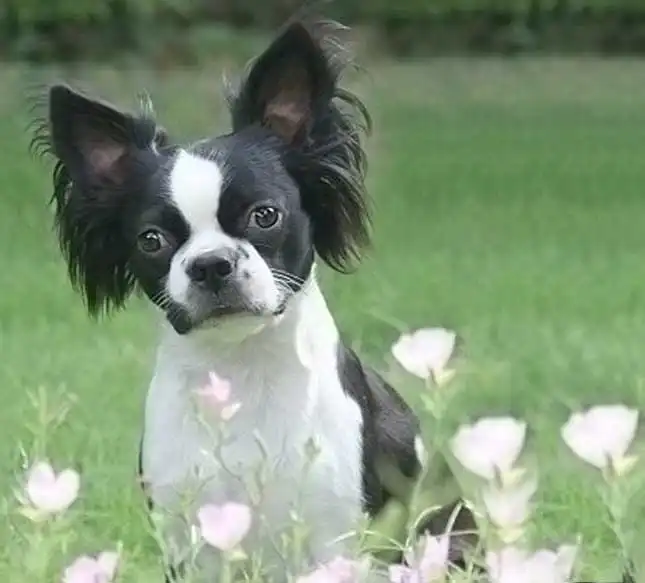
French Buillon
The French Buillon is a charming hybrid that merges the French Bulldog with the Papillon. Both of these parent breeds are small, loving, and friendly, making them excellent companions for individuals and other animals. Thanks to the traits inherited from its parents, the French Buillon is usually easy to care for. One parent is typically more relaxed, while the other is quite energetic, leading to varying exercise needs among individual dogs. Likewise, training can be affected by the characteristics of the parent breeds; one is often seen as stubborn, while the other is eager to please. In general, this mixed breed is fairly healthy, facing few health concerns, and usually has a lifespan ranging from 9 to 15 years.

Breed Origin
In recent years, the popularity of hybrid dog breeds has significantly increased, giving rise to a trend in designer dogs. One notable example is the French Buillon, a mix between a French Bulldog and a Papillon. While information on these newer breeds is somewhat scarce, we can explore the histories of their parent breeds. The French Bulldog is thought to be a descendant of the English Bulldog, which gained prominence in the 1850s and 1860s, particularly among lacemakers in Nottingham, England. As the breed's popularity declined in England, many were transported to France, where they likely interbred with other breeds and became favored by wealthy city women and rural landowners. They earned the name French Bulldogs due to their English lacemaker owners bringing them to France. Despite their initial popularity, their numbers dwindled during World War I and were hard to find throughout the Great Depression. However, the breed saw a resurgence in America during the 1980s and 1990s, which helped stabilize its population. Conversely, the Papillon has a more mysterious background, with limited information regarding its development. Some theories suggest it descends from the Japanese Chin and other Asian toy breeds, while others propose it originated from the smallest dogs within the same lineage. It is widely accepted that the Papillon is a contemporary version of the Dwarf Spaniel and the Continental Toy Spaniel, which were present in Europe as early as the 1200s. This breed frequently appeared in art, often depicted in the laps of noblewomen. The Papillon gained traction in Spain and was commonly traded in Bologna, Italy. Notably, in 1545, a woman who would later become the queen of Poland owned these dogs, and they were also introduced to France, where they were sold to Louis XIV. The breed made its way to England in 1901 and only recently made its debut in the United States during the 20th century.
Breed Appearance
This designer dog breed showcases characteristics that blend elements from both the French Bulldog and the Papillon. French Bulldogs are sturdy yet compact, easily recognized by their prominent, bat-like ears. Their noses resemble those of Pugs, and they have a flat, moderately sized head with a rounded forehead. The skin is soft and loose, and they may have tails that are either straight or corkscrew. Typically, this breed features an underbite and possesses large, round eyes, giving it a square overall appearance, with height at the withers approximately equal to the length from the withers to the tail. In terms of body shape, the French Bulldog has a pear-like silhouette, with broader shoulders than its hindquarters. Conversely, the Papillon is small and elegantly constructed, radiating an air of intelligence and alertness. Their signature butterfly ears, which can stand erect or droop (the latter variant being known as Phalene), are a defining feature. These ears are adorned with a long fringe, and their tails are gracefully plumed. The Papillon's muzzle is fine, tapering, and slender in relation to its head. Their eyes are round, medium-sized, and alert, while the topline remains level, complemented by a neck of moderate length.


Care Routine
Caring for the French Bulldog aspect of the French Buillon is quite simple. Their coats are low-maintenance, needing just weekly brushing without any clipping. Bathing is rare and, when it is necessary, it’s an easy process. In contrast, the Papillon's long, silky fur might appear to require more effort, but it is actually quite manageable. These dogs generally need to be brushed two to three times a week and do not need frequent baths. While occasional trims can be helpful, they are straightforward enough to do without professional grooming. The coat of your French Buillon can differ; it might be a harmonious mix of both parent breeds or may favor a shorter length if the French Bulldog genes are more prominent, or a longer length if the Papillon traits dominate. To ensure your dog's well-being, clean their ears monthly to help prevent infections. It's also crucial to maintain their dental health, which involves brushing their teeth daily or at least two to three times a week. Regular nail trimming is important as well, with checks and care needed every one to two months.
Behavior & Temperament
The French Buillon, much like its appearance, inherits a blend of personality traits from its parent breeds. Drawing from the French Bulldog, known for its exceptional companionship, these dogs are typically well-behaved and sociable, getting along well with both people and other animals. While they are generally easy to manage, they possess a playful nature and have a strong desire for attention, thriving on their owners' affection. This longing for companionship can result in separation anxiety, so it's advisable to avoid leaving them alone for long periods. Training can prove to be a bit challenging due to their stubbornness and tendency to lose interest in repetitive tasks. Employing positive reinforcement techniques, such as treats and praise, is much more effective than using harsh methods. In contrast, the Papillon is a clever breed that is not only easy to train but also enjoys being the focal point of attention, making them great companions for children. To nurture a calm, obedient, and confident French Buillon, it is crucial to provide appropriate training and socialization during their early developmental stages.


Play & Exercise
French Bulldogs flourish with several brief walks each day, paired with playtime. During the hot summer months, it's crucial to limit their activity to avoid the risk of heat stroke. It's also important not to let them swim, as this breed does not possess natural swimming skills and could be at risk of drowning without supervision. Always supervise a French Bulldog when they are near water. On the other hand, the Papillon is significantly more active and demands a higher level of daily exercise. They also thrive on mental challenges; activities like agility training or interactive games can effectively satisfy their need for stimulation. Generally, French Bulldogs have moderate exercise needs, displaying occasional bursts of energy while also appreciating downtime.
Things to Know
Cups Per Day
1.0 Cups
Daily Activity
60 Minutes
Average Lifespan
12 Years
Origin
Unknown
Type
Crossbreeds
Size
Small
Origin Country
Unknown
Brush Frequency
Weekly
Coat Texture
Straight
Register
Your kids have been begging for a pet forever, and you've recently decided that it's time for your family to get a new addition -- a dog! While everyone is excited for the new arrival, you're wondering if you need to have a dog license. How much does it cost? Is it required? Where do you get one?
Member Clubs

PETINNATE
Other
Height & Weight
Weight
17 lbs (8 kg)Male: 17 lbs (8 kg) , Female: 17 lbs (8 kg)
Height
10 inches (25 sm)Male: 10 inches (25 sm) , Female: 10 inches (25 sm)
Eye Colors
Brown

Nose Colors
Black
Coat Colors
Fawn
Brindle
White
Cream
Black