German Longhaired Sprointer
The German Longhaired Sprointer is a hybrid breed resulting from the cross between the German Longhaired Pointer and the Springer Spaniel, both renowned for their exceptional hunting abilities. These dogs are known for their friendly nature and boundless energy, along with a sharp and adaptable mind. They have a strong yet elegant build and are highly sensitive to their family's needs, demonstrating the endurance necessary for hunting, springing, and retrieving game over long durations. This spirited and joyful breed typically interacts well with children of all ages, though they may display excessive excitement around very young ones, particularly before they mature. The Sprointer thrives on social interaction and can suffer from separation anxiety if left alone for extended periods.
Breed Origin
The German Longhaired Sprointer is a meticulously designed hybrid dog, created through the intentional crossbreeding of the German Longhaired Pointer and the Springer Spaniel. Both breeds are known for their friendly and sociable nature, serving as hunting companions—one originating from England and the other from Germany. While Spaniels, including the Springer Spaniel, are classified as gun dogs, their hunting assistance dates back to a time before firearms were invented. Initially, these dogs were bred to flush out game from thick underbrush for bow hunters and, in some cases, to retrieve downed birds. The earliest spaniels were divided into two categories based on their hunting environments: water spaniels and land spaniels. In the 1600s, a further classification among land spaniels emerged, distinguishing them as either Springer or Cocker Spaniels, based solely on their size. The smaller Cocker Spaniels were used to flush both game and birds like woodcocks, while the larger Springer Spaniels, weighing over 28 pounds, earned their name from their ability to "spring" game for hunters. It wasn't until 1902 that the Kennel Club of England officially recognized Springer and Cocker Spaniels as separate breeds, with the American Kennel Club following suit in 1910. The German Longhaired Pointer began its development in Germany around the mid-1800s as a long-haired pointing breed. During its formative years, breeding records were not well-documented, but it is believed that local flushing dogs were crossed with English Setters, Pointers, and other breeds. Although various color patterns were present at the breed's inception, standards established in 1879 specified that these dogs should have brown or brown-and-white coats. This breed developed alongside the German Shorthaired and German Wirehaired varieties, which were only recognized as foundational stock by the American Kennel Club in 2010 and have yet to be acknowledged as a distinct breed.
Breed Appearance
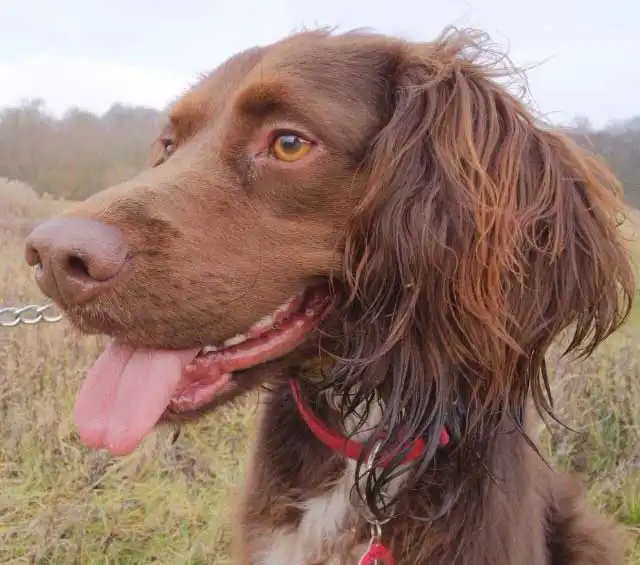
The German Longhaired Pointer is a strong and athletic breed, distinguished by its balanced head, which strikes a perfect harmony between being too heavy and too light. The skull is gently rounded, leading into a long, robust muzzle that has a somewhat square shape. Typically, these dogs have oval brown eyes, although hazel eyes can occasionally be found. Their long, rounded ears are positioned low on the head, hanging well below the jawline. Known for their powerful, muscular hips and thighs, they also sport a feathered tail that is carried horizontally behind them. Their coat consists of two layers: a thick, short undercoat protected by a tougher outer layer. This shiny outer coat can be either sleek and smooth, similar to that of the Longhaired Pointer, or slightly shorter and wavy, akin to the coat of the Springer Spaniel. Additionally, feathering is present on the ears, legs, feet, and tail.


Care Routine
It is recommended to bathe both the German Longhaired Pointer and the English Springer Spaniel roughly every six to eight weeks, a guideline that also applies to their puppies unless they become excessively dirty or muddy. Notably, German Longhaired Pointers are more prone to getting muddy than many other breeds, as they enjoy splashing in puddles and chasing objects through the muck. Fortunately, they do not typically experience issues with dry skin, even with regular bathing. To effectively manage shedding and avoid tangles and mats—particularly in the feathered areas around the ears, chest, legs, and belly—these dogs should be brushed several times a week. Special attention should be given to these areas, as they are particularly susceptible to tangling.
Behavior & Temperament
This hybrid breed is an energetic and intelligent dog, always curious about what lies ahead. They demonstrate a strong loyalty to their family, often forming a particularly close bond with one individual. This attachment can sometimes lead to clinginess, resulting in separation anxiety if they are left alone for long periods. German Longhaired Sprointers typically interact well with people of all ages, although their high energy levels may be too much for very young children. Their behavior around other dogs can differ; while some are quite friendly, others may be more reserved when encountering new dogs or situations. To effectively manage this sociable breed, it is crucial to provide early and consistent socialization and training, as some may exhibit ongoing same-sex aggression. Furthermore, they have a strong prey drive and are inclined to chase smaller animals, but early socialization can help reduce this tendency.


Play & Exercise
German Longhaired Sprointers are vibrant and spirited dogs that require a significant amount of exercise, typically ranging from 90 to 120 minutes daily, though they would happily accept even more. Beyond just walking and jogging, these dogs relish a variety of activities, including hunting, tracking, swimming, and playing fetch. Their high energy levels are complemented by sharp intelligence, so it’s crucial to offer them mental stimulation to prevent any unwanted behaviors, such as barking or restlessness. These dogs thrive in open spaces and are most content when they can run and explore freely, making them less ideal for living in apartments.
Things to Know
Cups Per Day
3.0 Cups
Daily Activity
120 Minutes
Average Lifespan
12 Years
Origin
Unknown
Type
Crossbreeds
Size
Large
Origin Country
Unknown
Brush Frequency
Weekly
Coat Texture
Wavy
Register
Your kids have been begging for a pet forever, and you've recently decided that it's time for your family to get a new addition -- a dog! While everyone is excited for the new arrival, you're wondering if you need to have a dog license. How much does it cost? Is it required? Where do you get one?
Member Clubs

PETINNATE
Other
Height & Weight
Weight
60 lbs (27 kg)Male: 60 lbs (27 kg) , Female: 60 lbs (27 kg)
Height
24 inches (61 sm)Male: 24 inches (61 sm) , Female: 24 inches (61 sm)
Eye Colors
Brown

Nose Colors
Black
Coat Colors
Black

Brown