Muggin
The Muggin is a spirited and loving dog, celebrated for its joyful disposition. This breed typically forms a deep bond with its preferred human, often seeking to remain in close proximity. Although small in stature, the Muggin is brimming with energy and requires ample physical activity. Fortunately, they generally interact well with children and other dogs, making them a great option for families. However, their propensity to bark often could pose challenges in an apartment setting. Moreover, training a Muggin can be a bit challenging, so they are likely best suited for owners who have some experience in pet ownership.
Breed Origin
The Muggin is a recently created hybrid dog breed that lacks a detailed historical narrative. In contrast, the two breeds that form its foundation boast rich and extensive histories. The Miniature Pinscher, resembling a diminutive Doberman Pinscher, has ambiguous origins, though it is widely regarded as an ancient breed, possibly existing for around 2,000 years. Comprehensive records of the Miniature Pinscher began to surface in the 1800s. It is generally accepted that this breed is part of the German Pinscher lineage, with indications that the Italian Greyhound and Dachshund may also contribute to its ancestry. By the late 1800s, initiatives to refine the Miniature Pinscher were in progress, culminating in the establishment of the Pinscher Klub in Germany. The breed arrived in the United States in the early 1900s, where it gained popularity, leading to the formation of the Miniature Pinscher Club of America and receiving official recognition from the American Kennel Club in 1929. Initially bred for rat control, the Miniature Pinscher has evolved primarily into a companion animal. Conversely, the Pug has its roots in China during the Han dynasty, approximately between 206 B.C. and 200 A.D. These dogs were highly valued by Chinese emperors, who treated them with great reverence. Similar breeds have been found in ancient Tibet and Japan. When Dutch traders brought Pugs to Europe in the 1500s and 1600s, they were known as Mopshond and quickly became favorites among royal families. The breed has been referred to by various names, including Carlin in France, Doguillo in Spain, Mops in Germany, and Caganlino in Italy. By the 1800s, two main breeding lines had developed in England: the Morrisson line, derived from Queen Charlotte’s royal dogs, and another established by Lord and Lady Willoughby de Eresby, based on dogs imported from Hungary and Russia. During the Victorian Era, the Pug became a popular motif in postcards, figurines, and paintings. After the Civil War, the breed made its way to the United States and was officially recognized by the American Kennel Club in 1885.
Breed Appearance
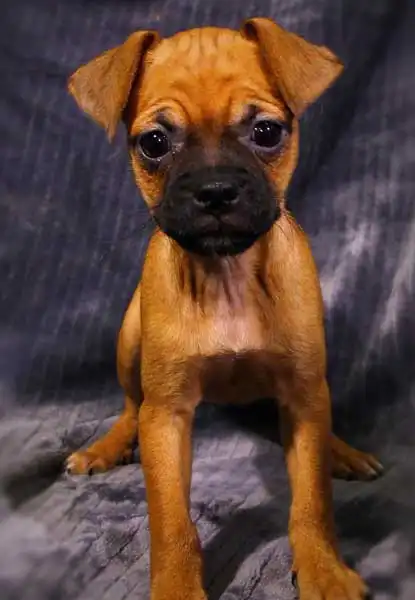
The Muggin's look is shaped by the traits it inherits from its parent breeds. It may exhibit the Pug's distinctive short snout and curled tail, or it might take after the Miniature Pinscher with a longer snout and a more compact tail. While Pugs typically have small, slender ears, Miniature Pinschers boast ears that sit high on their heads. Muggins come in a range of colors, including cream, black, brown, gold, and white, and they can also feature combinations like black and tan. In general, Muggins have a short, fine coat that tends to shed quite a bit.


Care Routine
The Muggin will undergo regular and heightened shedding during the spring and winter seasons. To effectively manage this, it’s crucial to brush your dog daily and frequently vacuum your floors and furniture. Maintaining the Muggin's short coat is straightforward with a durable brush. It's advisable to bathe your Muggin only when absolutely necessary, as over-bathing can result in dry skin problems. To help minimize shedding, you can use a damp cloth to wipe your dog down. Furthermore, for optimal dental health, it’s recommended to brush your Muggin's teeth at least twice a week. Regular nail trimming should be performed as needed, and you should inspect his ears weekly for any signs of infection.
Behavior & Temperament
The Muggin is a warm and affectionate companion who loves to curl up next to you while you enjoy a book or watch TV. One of his primary ways of showing affection is by giving his favorite humans plenty of loving licks. While this hybrid may bark at unfamiliar noises or new faces, he quickly calms down once he determines there’s no danger, showcasing his gentle nature. The Muggin can suffer from separation anxiety, becoming uneasy when you leave, as he worries you might not come back. Having another dog around can help alleviate his stress. He typically gets along well with children, though he might nip if he feels they are being overly rough.


Play & Exercise
While Pugs are generally known for their laid-back nature, Muggins often inherit a more lively temperament from their Miniature Pinscher ancestry. This breed usually benefits from daily walks—preferably once or twice a day—along with opportunities for play both indoors and outdoors. If you notice your Muggin acting out, it may be a sign that it requires more physical and mental engagement to help manage its energy levels and stave off boredom. Given their tendency to gain weight, consistent exercise is essential for keeping them in good shape. Muggins can adapt well to living in apartments, as long as they have plenty of chances for outdoor activities and playtime.
Things to Know
Cups Per Day
1.0 Cups
Daily Activity
50 Minutes
Average Lifespan
14 Years
Origin
Unknown
Type
Crossbreeds
Size
Small
Origin Country
Unknown
Brush Frequency
Daily
Coat Texture
Straight
Register
Your kids have been begging for a pet forever, and you've recently decided that it's time for your family to get a new addition -- a dog! While everyone is excited for the new arrival, you're wondering if you need to have a dog license. How much does it cost? Is it required? Where do you get one?
Member Clubs

PETINNATE
Other
Height & Weight
Weight
16 lbs (7 kg)Male: 17 lbs (8 kg) , Female: 15 lbs (7 kg)
Height
12 inches (30 sm)Male: 12 inches (30 sm) , Female: 11 inches (28 sm)
6 Months
7 lbs ( m 7 lbs, f 7 lbs )
5 inches ( m 5 inches, f 5 inches )
12 Months
13 lbs ( m 13 lbs, f 13 lbs )
10 inches ( m 10 inches, f 10 inches )
18 Months
15 lbs ( m 15 lbs, f 15 lbs )
11 inches ( m 11 inches, f 11 inches )
Eye Colors
Brown
Nose Colors
Black
Brown
Coat Colors
Cream
Black
Brown
White