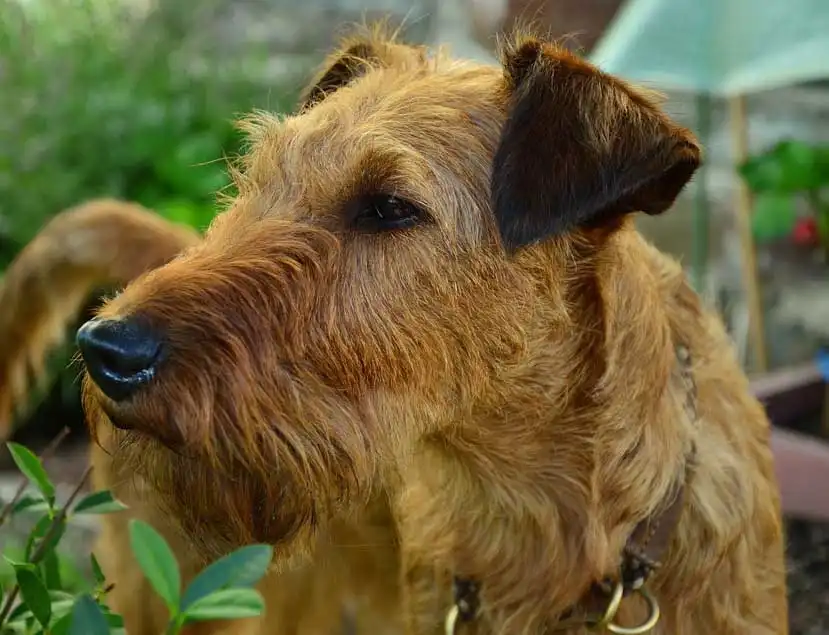
Irish Terrier
Irish Red Terrier, Daredevil
The Irish Terrier, celebrated for its spirited and adventurous nature, holds the distinction of being the oldest among all Terrier breeds, although its exact origins are somewhat ambiguous. Historical documentation suggests that by the 17th century, this breed was esteemed in Ireland for its prowess in hunting vermin and serving as a guard dog on rural farms. By the 18th century, the Irish Terrier had become popular in dog shows throughout Ireland, England, Scotland, and even the United States. Today, this medium-sized dog, known for its wiry coat, is treasured as a loyal, joyful, and energetic family companion. While it requires little grooming, this resolute breed demands plenty of daily exercise, along with early socialization and training to flourish.
Breed Origin
The Irish Terrier is considered the oldest of all Terrier breeds, although its historical background is not well-documented. The first known representations of this lively breed appear in 17th-century art. Believed to have originated in Ireland, it may trace its roots to the Black and Tan Terrier or possibly the Irish Wolfhound. Some hypotheses even propose that it could be a variation of the lowland Scottish Terrier. Early examples of the breed were commonly found in gray and brindle or black and tan colors, while the striking red coat that is now characteristic of the breed only became prominent in the 19th century. This change in coloration might have led to its nickname “Daredevil,” although it more likely reflects the breed's bold and fearless nature. In Ireland, these Terriers were employed for various roles, such as farm work, hunting vermin, and guarding properties. Their adventurous spirit also saw them serve as messengers and sentinels during World War I. The breed gained popularity in late 19th-century England, where ear cropping became a trend. The Irish Terrier was first officially showcased as a recognized breed in Scotland in 1875, and the American Kennel Club acknowledged it in 1885. In 1889, the Terrier Club of England banned ear cropping for this breed, a rule that later applied to all show breeds in the country. The spirited nature of the Irish Terrier continued to attract admirers, and by the late 1920s, it was ranked as the 13th most popular breed in the United States.
Breed Appearance
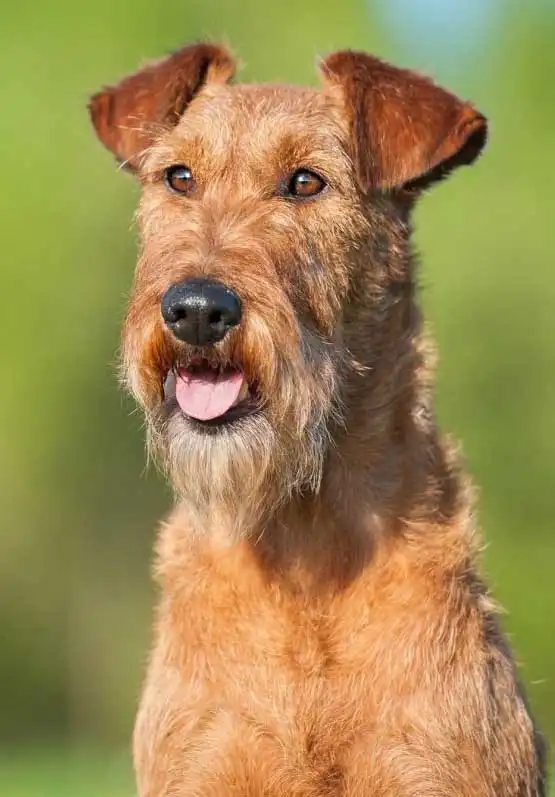
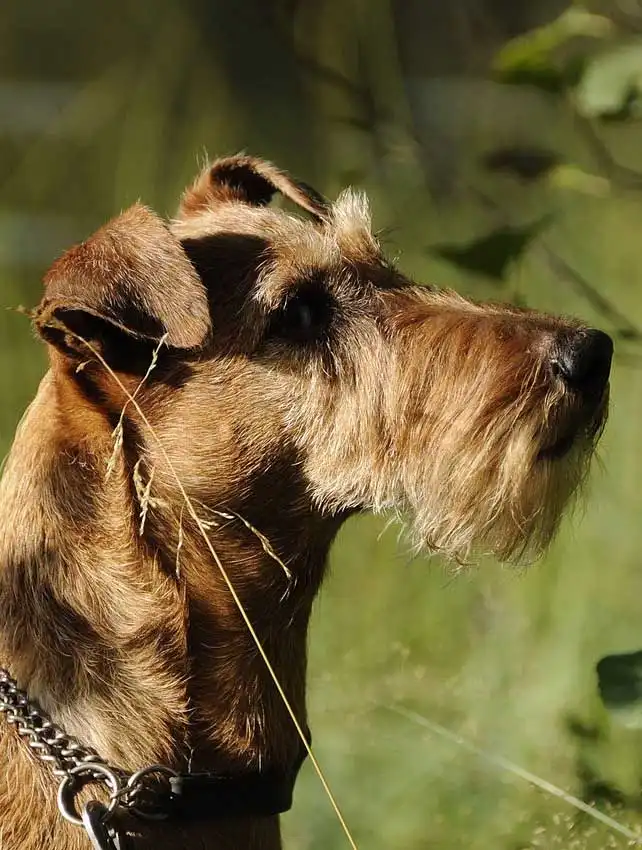
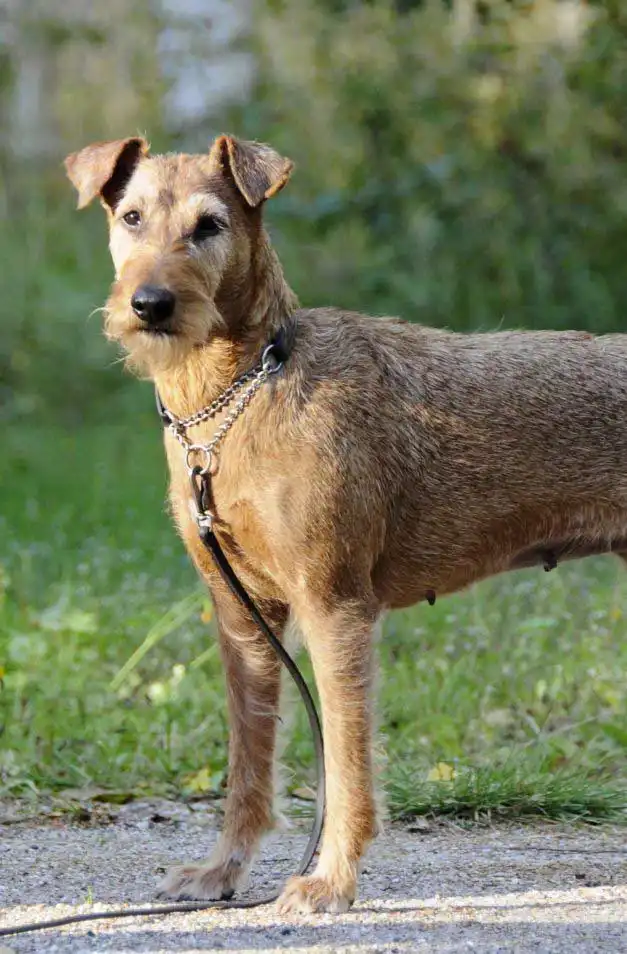
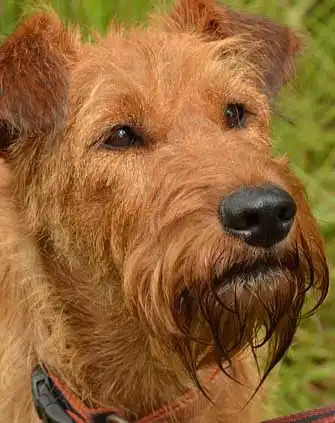
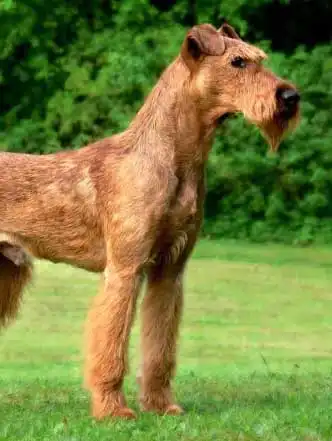
The Irish Terrier is frequently regarded as the most refined among Terrier breeds, distinguished by its elongated legs and body, which lend it a strong and athletic appearance. This breed boasts a well-proportioned build, featuring a back that is longer than that of other Terriers. Its head is elongated and slender, with a flat skull. The muzzle, which is complemented by a beard and long whiskers, hides a powerful jaw. Its small, dark eyes, framed by bushy eyebrows, create a captivating expression. The ears, shaped like a V, fold forward and have shorter, darker fur compared to the rest of the coat. The tail is set high and carried upright, traditionally docked to about a quarter of its original length in the United States. The coat is made up of dense, wiry hair that is thick on the surface, often referred to as "broken," indicating it is neither curly nor straight, with a soft undercoat underneath. Irish Terriers are usually found in solid colors, including wheat, gold, and the most prevalent hue, red.
Care Routine
This breed is quite easy to care for, needing only a weekly brushing due to its short, dense coat that doesn’t shed much. It’s recommended to either strip or clip the coat two to four times a year; stripping effectively eliminates dead hairs, while clipping is easier but may leave the coat too soft for competitive events. Baths should be given only when necessary. Furthermore, the Irish Terrier has rapidly growing nails that require regular trimming to avoid splits and cracks. Regular attention to the ears and teeth is also crucial for keeping the dog looking its best. As an energetic and intelligent breed, the Irish Terrier thrives on daily exercise. Although it can adapt to living in an apartment, it requires both mental stimulation and physical activity to avoid boredom and unwanted behaviors. Providing a fenced yard and taking walks on a leash can help satisfy its natural instincts to roam and chase.
Behavior & Temperament
This energetic and clever dog is an ideal match for an active family. Often dubbed a “daredevil” due to his adventurous nature, he needs plenty of exercise; if not, he might dig his way out of the yard in search of thrills. This loving and playful breed is loyal to his owner and enjoys interacting with children. He may display protective instincts, barking at strangers to keep his family safe. The Irish Terrier is spirited and tends to stand firm when confronted, which can sometimes lead to aggression towards other animals. His territorial instincts, coupled with a strong prey drive, can make it challenging for him to live harmoniously with other pets. While he can learn to coexist with cats if raised together, he generally does best as the only dog in the home. This intelligent breed requires consistent and firm training, which can be demanding due to his cleverness. Setting clear boundaries and ensuring early socialization are crucial for helping him feel at ease around new people. Above all, the lively Irish Terrier seeks attention from his family and needs ample exercise. Although he behaves well indoors, he requires daily play and physical activity; without it, he may become quite the handful.
Play & Exercise
Things to Know
Cups Per Day
2.5 Cups
Daily Activity
60 Minutes
Average Lifespan
14 Years
Origin
1700s
Type
Pure Breeds
Size
Medium
Origin Country
Ireland
Brush Frequency
Weekly
Coat Texture
Wiry
Register
Your kids have been begging for a pet forever, and you've recently decided that it's time for your family to get a new addition -- a dog! While everyone is excited for the new arrival, you're wondering if you need to have a dog license. How much does it cost? Is it required? Where do you get one?
Member Clubs

PETINNATE
Terrier

AKC
Terrier Group

UKC
Terrier
Height & Weight
Weight
26 lbs (12 kg)Male: 26 lbs (12 kg) , Female: 25 lbs (11 kg)
Height
17 inches (43 sm)Male: 18 inches (46 sm) , Female: 17 inches (43 sm)
6 Months
15 lbs ( m 15 lbs, f 15 lbs )
13 inches ( m 13 inches, f 13 inches )
12 Months
20 lbs ( m 20 lbs, f 20 lbs )
14 inches ( m 14 inches, f 14 inches )
18 Months
25 lbs ( m 25 lbs, f 25 lbs )
17 inches ( m 17 inches, f 17 inches )
Eye Colors
Brown

Nose Colors
Black
Coat Colors
Red

Cream
Fawn